
Peter Gauthier
My engineer's mind decided it's time to build putters suited to the faster greens of today.
SLED putters are designed to improve consistency at impact for every level of player, from a tour pro to a recreational golfer. Consistency is one of the most important traits of elite putters.
I believe in measurable performance, not just aesthetics. We've all seen things that look good, but simply don't perform very well - cars, people and even putters.
My putters are designed with rock-solid science for performance.
Background
- Green Speeds - Average
The average speed in the 1970's was 7.0'. Today, the average is about 9.5' to 10.5'. Championship tour greens run between 11.5'-13.0'. The average grass height has gone from 0.210" in the 1970's to 0.125"-0.100". - Static Loft
Putter lofts have gone from 6°-7° in the 1970's to a few putters being 2.5° now. Many are still 3°-4°. Loft was needed to lift the ball out a depression the ball made resting on the grass. The ball no longer rests in a depression on fast greens, so excess loft only launches the ball with backspin, which adds... - Bounce and Skid
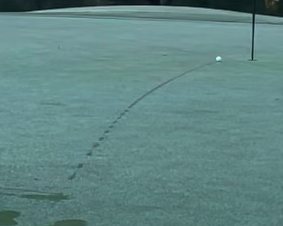
Putts bounce and skid initially up to 20% of the distance to the hole before true roll with traditional putters - see the photo. So, a 20-foot putt bounces and skids up to 4.0', losing energy along the way.
So, what do we want?
- Energy
You want to transfer as much of it as possible at impact. "Impact Ratio" (IR) is ball speed/putter head speed - it's like smash factor, but dressed up in a suit. You want the highest and most consistent transfer. The vertical and horizontal center of the face is where you want to make contact. Unfortunately, many players make impact at the bottom of the face as the putter is rising at impact as they try to add "topspin." That putt has less energy, launches with back spin and loses more energy, and that's why a 20-foot putt right in the jaws ends up about 2 feet short. The SLED is elevated so you always strike the center of the ball at the center or above the center of the face. See photo of 50 putts with the SLED. The SLED also has the highest energy transfer of all putters tested so far. - Delivered Loft
The ideal loft at impact on the greens of today is 2° or less. Manipulating your stroke by a forward press or de-lofting during the stroke (and lifting the putter precisely 0.34" to make center of face contact at or above equator of the ball) can be inconsistent. The SLED is 2° loft and already elevated to the center of the ball, so no manipulation is needed. Just hit it. - Bounce and Skid
You want to get the ball rolling end-over-end as soon as possible. The SLED can give you forward spin immediately off the face. All other putters tested so far have backspin. The SLED bounces less, skids less and starts rolling end-over-end faster. On a 20-foot putt, the SLED has true roll in an average of 2.8', about one foot or more faster than traditional putters.
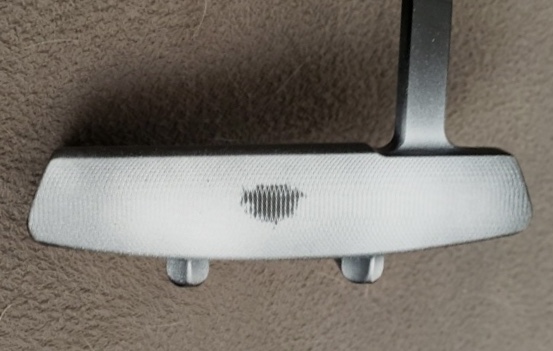
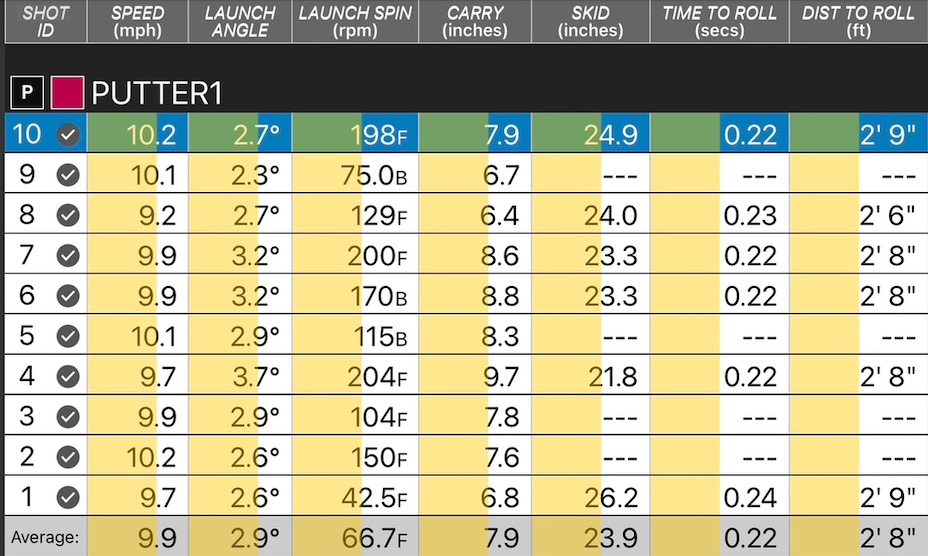
The SLED on an uphill 20-foot putt on Paspulum grass, a thick blade that grows in all directions
- Rolls end-over-end faster and rolls out more with less bounce and skid. True roll starts at 2' 8" instead of up to 4 feet.
- The center of the putter is elevated to the equator of the ball for pure, consistent contact. Distance control improves immediately.
- Has 2° loft for a low net launch of 3° with forward spin off the face. We've yet to find any other putter with forward spin.
- Has a lowered center of gravity to improve natural momentum of the head through the stroke.
- Tracks through fringe, fairway and rough near the green, keeping the head straight through impact. It's the ultimate Texas wedge.